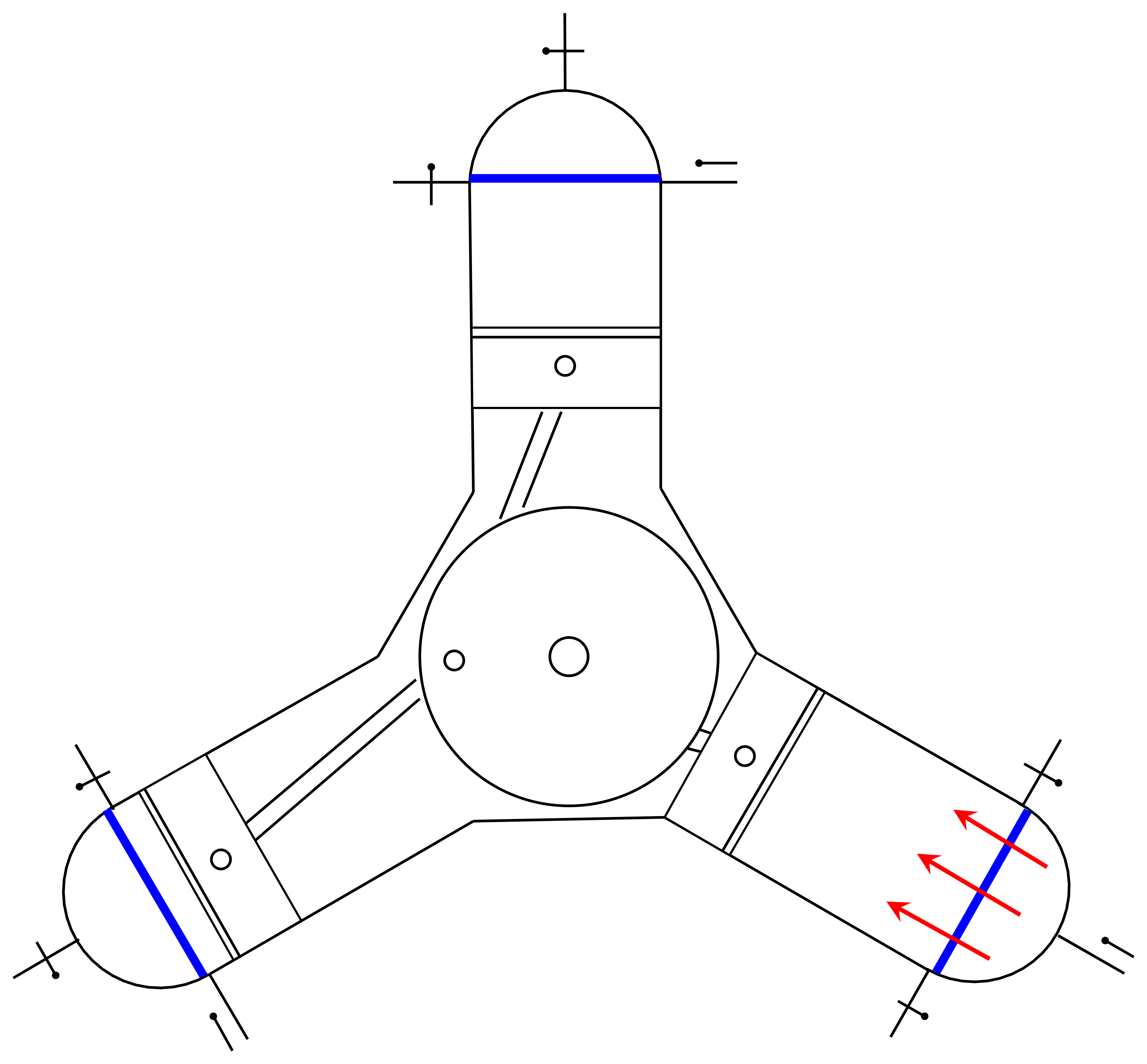
Building the first osmotic engine prototype together
The primary purpose of this website is to bring together researchers, companies and other interested partners to form a research and development consortium with a shared ambition: To design, build and study the first prototype of an osmotic engine.
Osmogine welcomes partners with complementary expertise who wish to contribute to this joint effort—from membrane technology and mechanical design to instrumentation, thermodynamic measurements and experimental validation.
A central aim is to investigate how the osmotic engine can serve as the measuring mechanism in a new type of osmometer: an instrument designed to determine the Gibbs free energy of mixing of solutions, , from measurable changes in pressure and volume.
Controlled osmosis as a measurement technology
The idea is to use controlled osmosis as an experimental measurement method. Solvent passes through a semipermeable membrane into a test solution while an opposing pressure is regulated to keep the osmotic process close to equilibrium. The mechanical effect of osmosis can thereby be recorded as a pressure–volume process and related to the thermodynamics of the solution.
In this context, the osmotic engine is not primarily intended as a device for generating power. It provides the measuring mechanism of the osmometer: A controlled mechanical process through which osmotic dilution can be followed step by step.
The aim is to translate a thermodynamic relation into a practical measurement principle for non-ideal solutions.
For a brief introduction to the technology, explore the slide shows or read the popular science article in Dansk Kemi (in Danish). A more detailed scientific treatment is available in the PCCP paper.
Scientific paper: D. W. Nielsen and C. Helix-Nielsen, Phys. Chem. Chem. Phys., 2026, 28, 11465–11477, DOI: 10.1039/D5CP03542B.
Why a new osmometer?
The Gibbs free energy of mixing is a fundamental thermodynamic property of a solution. It describes the thermodynamic driving force for mixing and is related to activities, activity coefficients, chemical equilibria and phase stability.
In practice, such properties are often determined indirectly from other measurable quantities, followed by thermodynamic modelling. A conventional osmometer, for example, measures osmotic pressure at a given composition but does not, by itself, provide the free energy of mixing as a directly measured quantity.
Osmogine’s idea is to take this a step further.
By following the osmotic process through a controlled change in both pressure and volume, the maximum useful osmotic work can be determined. This work provides an experimental route to the Gibbs free energy of mixing.
The central question is therefore: Can a controlled osmotic process be used as a quantitative measurement method for ?
If so, osmometry could be used not only to measure osmotic pressure but also to provide a more direct experimental approach to the thermodynamics of solutions.
From theory to a working prototype
The thermodynamic basis of the method is described in the PCCP paper. The next essential step is to translate the principle into a working prototype of the osmotic engine and investigate its performance as a measuring instrument.
The aim is to construct an osmometer in which the test solution is separated from the solvent by a semipermeable membrane, and in which solvent transport, volume changes and opposing pressure can be precisely controlled and measured.
By taking the process through a series of states close to osmotic equilibrium, corresponding pressure and volume values can be recorded. This makes it possible to determine the osmotic work and, from it, the free energy of mixing of the solution.
The prototype will primarily be used to establish whether this measurement method can be implemented with the required precision and reproducibility.
Where could the method be useful?
Experimental access to the free energy of mixing could be valuable in systems where deviations from ideal behaviour are important.
Potential areas of interest include non-ideal solutions, polymer solutions, proteins and other biomolecules, concentration-dependent conformational changes, phase separation and chemical equilibria.
What these systems have in common is that intermolecular interactions influence the thermodynamics of the solution, and this information is not necessarily captured by concentration alone.
Osmogine’s long-term aim is therefore not simply to develop another instrument for measuring osmotic pressure, but to investigate whether controlled osmosis can become a general thermodynamic measurement technology.
About Osmogine
Osmogine was founded by Dennis Wowern Nielsen, who holds an MSc in Engineering in chemistry from the Technical University of Denmark, DTU.
The work grew out of the development of the osmotic engine and the subsequent thermodynamic analysis of the relationship between controlled osmosis, osmotic work and the Gibbs free energy of mixing.
The theoretical foundations have been published in Physical Chemistry Chemical Physics.
The current goal is to bring together the partners and expertise needed to advance from the thermodynamic description to a working prototype and an experimental osmometer.
Join the collaboration
Building and studying the first prototype requires expertise in membrane technology, precision mechanics, instrument development, control engineering and physicochemical measurements.
Osmogine is therefore seeking to establish a research and development consortium of research groups, universities, companies and other specialist partners with a shared interest in developing and investigating the first osmotic engine prototype.
The consortium would bring together complementary capabilities to design and construct the prototype, study its operation and validate the measurement principle using well-characterised solutions.
Researchers and companies interested in contributing to this work are warmly invited to get in touch and discuss potential roles in the collaboration.
A talk can also be arranged on the osmotic engine, controlled osmosis and the prospects for using osmosis as a thermodynamic measurement technology.
Contact: contact@osmogine.dk